
Private AI vs Public AI: Which Is Right for Your Enterprise?
The Short Answer
Public AI means using a general-purpose AI model as a shared service over the internet. Your prompts and data are processed on infrastructure someone else owns and controls. Private AI means running AI inside an environment you control, whether that is on-premises, in a private cloud, or in a dedicated tenancy, so your data, models, and logs stay within your governance perimeter.
Most enterprises end up using both. Public AI handles the general, low-sensitivity work. Private AI handles anything touching regulated data, proprietary IP, or systems that carry compliance obligations.
So the real question is not which one to buy. It is which workloads belong where, and what it costs you to draw that line in the wrong place.
Five Numbers Worth Knowing Before You Decide
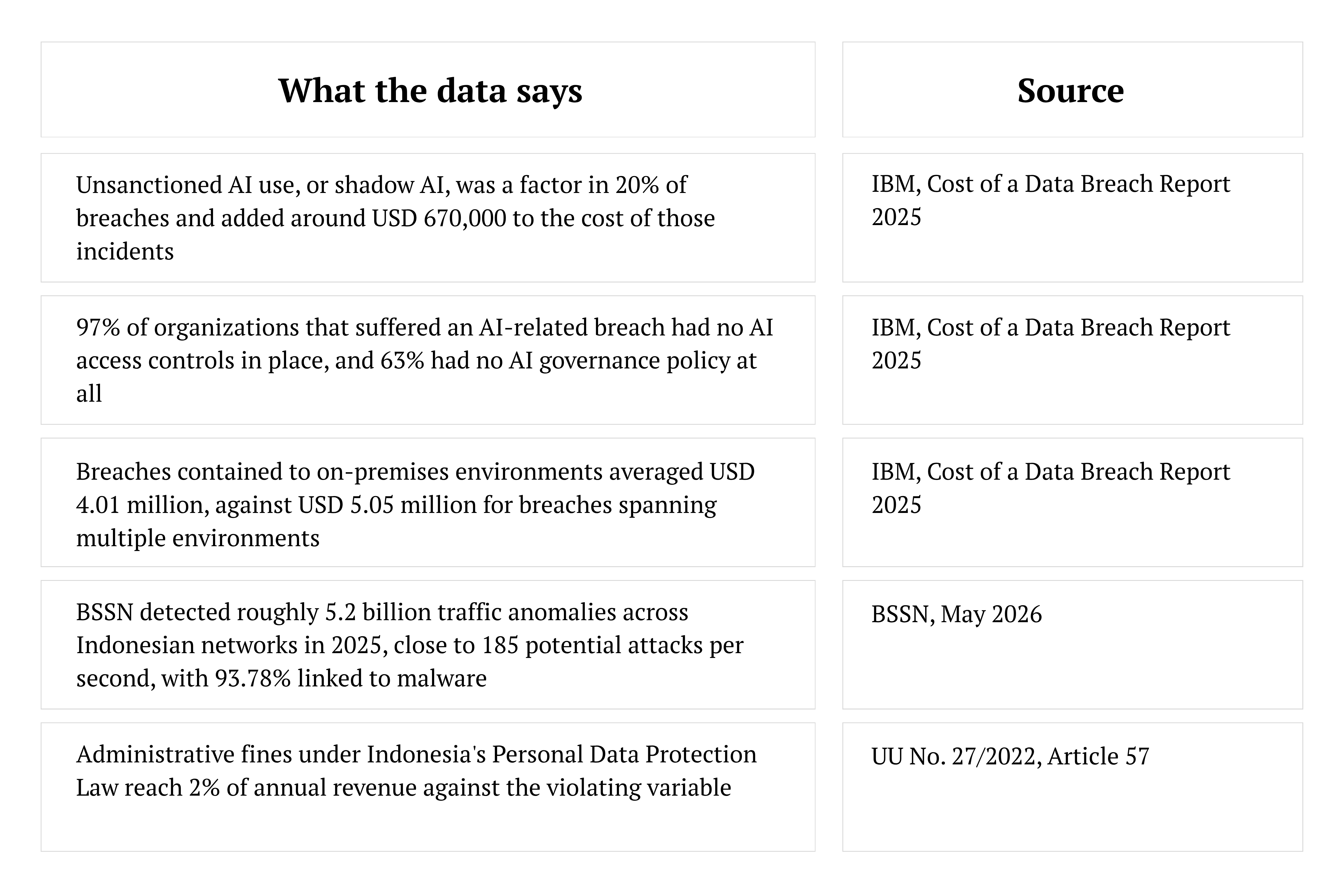
Read those together and a pattern emerges. The expensive failure is not choosing the wrong deployment model. It is deploying either model without governance, then finding out what your people were doing after the fact.
What Is Public AI?
Public AI refers to AI models and services consumed as a shared, multi-tenant utility, usually through a web interface or a public API. The provider trains the model, hosts it, secures it, and upgrades it. You consume the intelligence and pay for what you use.
A few things define it:
Shared infrastructure. Compute is pooled across many customers.
The provider owns the data path. Your prompts and outputs travel to and are processed on third-party systems, often in another country.
Consumption pricing. You pay per token, per seat, or per call. Upfront cost is close to zero.
You inherit upgrades. New model versions arrive without a migration project on your side.
Customization is shallow. You can prompt, retrieve, and sometimes fine-tune, but only within the limits the provider sets.
Public AI works well for content drafting, market research, translation, general coding help, meeting summaries, and early experiments where you are still trying to prove a use case is worth funding.
What Is Private AI?
Private AI refers to AI systems that run inside infrastructure your organization controls, where you decide data residency, access rules, model behavior, and what gets logged. It is a control model, not a product category, and it comes in several shapes.
Deployment model | What it means | Who it suits |
On-premises | Models run on hardware you own, inside your own data center | Highest-sensitivity environments, including air-gapped operations |
Private cloud | Models run on isolated, single-tenant infrastructure hosted by a provider | Organizations that want control without buying hardware |
Sovereign cloud | Deployment stays inside national territory, under domestic jurisdiction | Government, defense, and regulated strategic sectors |
Hybrid | Sensitive inference stays private, everything else routes to public AI | Most large enterprises, once they get past the pilot stage |
What you gain: your data stays where you put it, since prompts, embeddings, retrieved documents, and logs never leave your perimeter. Every inference can be logged and attributed, which regulated industries need and rarely get from public services. You can fine-tune on proprietary data and internal language without shipping that data anywhere. And once infrastructure is paid for, the marginal cost of each inference is low.
What you take on: model updates, GPU capacity planning, patching, monitoring, and lifecycle management all become your problem. This is the part most business cases underestimate.
Private AI vs Public AI: Side by Side
Dimension | Public AI | Private AI |
Data residency | Provider-controlled, often cross-border | You control it, can stay fully onshore |
Regulatory defensibility | Depends on provider contracts and transfer mechanisms | Demonstrable control, strongest audit position |
Time to first value | Days to weeks | Weeks to months |
Upfront investment | Minimal | Substantial: infrastructure, GPUs, integration, people |
Cost at scale | Grows with every user and every call | Amortizes, wins on TCO at sustained high volume |
Model capability | Access to frontier models | Open-weight or licensed models, and the gap is closing |
Tuning on proprietary data | Limited | Full fine-tuning and domain adaptation |
IP exposure | Needs contractual and technical controls | Structurally contained |
Operational burden | Low, the provider carries it | High, you need MLOps and security capability |
Integration with internal systems | Constrained by network and security boundaries | Native, including operational technology |
Latency for on-site use | Depends on the internet path | Can run at the edge, next to the data |
Why This Decision Is Different in Indonesia Right Now
Four things have moved this from an IT architecture debate into a board-level risk conversation.
UU PDP is fully in force
Law No. 27 of 2022 on Personal Data Protection has been binding on every data controller and processor since 17 October 2024, when the two-year transition period ended. Under Article 57, the supervisory authority can issue written warnings, suspend your data processing activities, order data erasure, or impose administrative fines calculated against annual revenue. Criminal and civil exposure sits on top of that.
Pushing customer, employee, or health data into an AI service without a lawful basis and proper safeguards is now a number your CFO can calculate.
The threat environment is not theoretical
BSSN's 2025 monitoring figures, summarized above, describe a national network under continuous pressure. The agency has also been candid that its visibility currently reaches less than 10% of national internet traffic, which means the observed volume is a floor rather than a ceiling.
Set that next to IBM's finding on missing AI access controls and the risk of an ungoverned AI rollout stops being abstract.
Sector regulators have already moved
Banking is the clearest example. On 29 April 2025, OJK issued the Tata Kelola Kecerdasan Artifisial Perbankan Indonesia, a governance handbook that sets a minimum standard for how banks develop and deploy AI, including advanced AI systems. It covers the full lifecycle, from initiation and design through model development, testing, implementation, monitoring, evaluation, and periodic audit. It sits alongside existing rules such as POJK 11/POJK.03/2022 on IT implementation and SEOJK 29/SEOJK.03/2022 on cyber resilience, and it connects explicitly to obligations under the Personal Data Protection Law.
For a bank, that changes the question. You are no longer asking whether an AI tool is useful. You are asking whether you can evidence its lifecycle governance to a supervisor. That requirement points hard toward architectures where you control the logs.
National AI rules are close
The Ministry of Communication and Digital Affairs has been finalizing two Presidential Regulations, one covering the National AI Roadmap for 2026 to 2029 and one covering AI ethics. Both were still pending as of mid-2026, held up by inter-ministerial coordination and stakeholder consultation, with enactment expected before the end of the year. Indonesia has signalled a risk-based, flexible approach rather than the sanctions-heavy structure of the EU AI Act, but the direction is consistent: transparency, accountability, and safety obligations that reach across the whole AI lifecycle and apply to data providers, developers, and operators alike.
If you build on an ungoverned foundation now, you will pay to retrofit it later.
The practical effect of all four points is that data classification, not preference, decides most of this. The organizations moving fastest on AI in Indonesia are the ones that classified their data first and picked infrastructure second.
What Mature Organizations Actually Do
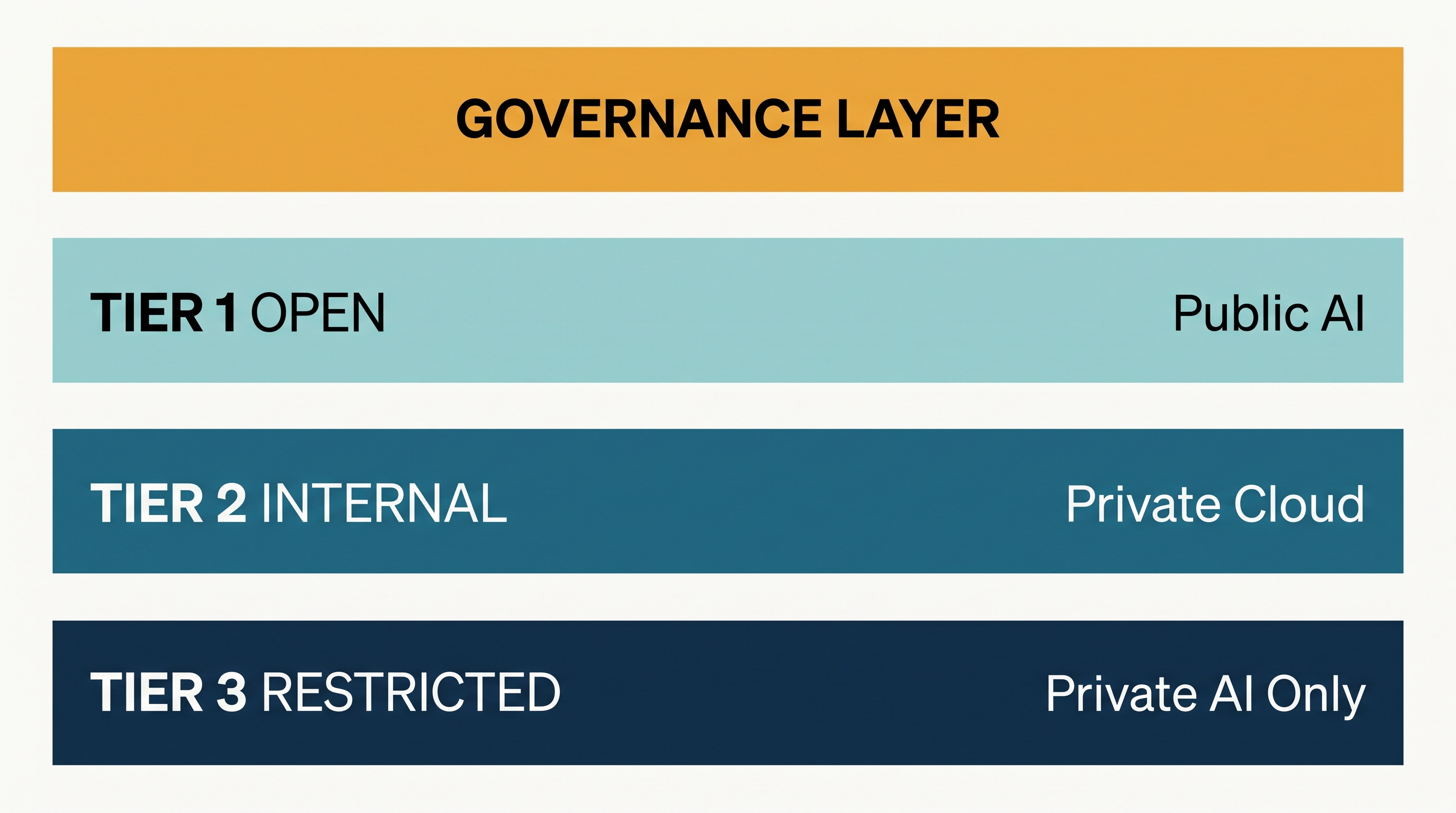
They rarely pick one model. They classify data, then route workloads to match.
Tier | Data type | Where it runs | Typical workloads |
Tier 1: | Public, non-sensitive, no personal data | Public AI | Marketing content, general research, public document summaries |
Tier 2: | Business-confidential, no regulated personal data | Public AI with enterprise controls, or private cloud | Internal documentation, non-sensitive analytics, general operations support |
Tier 3: | Personal data, financial records, IP, operational systems | Private AI only | Customer service on account data, credit analysis, clinical support, network operations, predictive maintenance |
Above all three tiers sits the governance layer: identity, access control, prompt logging, data loss prevention, and routing policy. That layer is where most organizations are actually exposed, and IBM's governance findings put a figure on how common the gap is.
It also explains where the real risk lives. Most uncontrolled AI exposure inside companies does not come from a procured platform. It comes from staff pasting sensitive material into personal accounts because nothing sanctioned exists. Indonesia is a high-exposure market for this, not a low one. Microsoft's Work Trend Index 2026 placed Indonesia among the leading markets in Asia for advanced workplace AI use, with 93% of Indonesian AI users treating model output as a starting point rather than a finished answer, above the global average of 86%.
That is a workforce already using these tools with some maturity. If you have not given them an approved option, shadow AI is already your architecture. You just have not documented it.
Five Questions That Settle It
Score each one from 1 (points to public) to 5 (points to private). Anything above 18 means private or hybrid should be your default.
How sensitive is the data? What is the highest classification of data that will enter the system? Public data scores 1. Regulated personal or biometric data scores 5.
What happens if you get compliance wrong? Minor inconvenience scores 1. Something that threatens your licence scores 5.
Is this a pilot or a permanent workload? A short experiment scores 1. Multi-year production at volume scores 5.
How deep is the integration? A standalone tool scores 1. Something embedded in core or operational systems scores 5.
Can you actually run it? No internal capability scores 1. Strong internal or partner capability scores 5.
Read the result carefully. If questions 1 through 4 score high and question 5 scores low, you do not have a technology problem. You have a capability problem, and the answer is a managed private AI arrangement rather than either extreme. Building infrastructure you cannot operate is worse than not building it.
The Cost Conversation, Without the Marketing
Private AI often gets justified on cost, and the model behind that justification is often wrong. A defensible TCO comparison has to include everything.
For private AI, that means accelerator hardware, data center space and power, networking, storage, model licensing where it applies, integration and data pipeline work, security tooling, MLOps talent, and day-to-day operations. A large share of the cost is people rather than hardware, and people are a recurring line item.
For public AI, it means token or seat consumption, egress and integration costs, security and DLP tooling, governance overhead, and the lock-in risk you accept. Notice the shape of it: cost rises as adoption succeeds. The better your program performs, the more you pay.
Where the two lines cross depends mostly on sustained inference volume. Light or sporadic usage favors public AI clearly. Heavy, predictable, continuous workloads favor owned infrastructure. In practice, most enterprises overestimate their early volume and underestimate their operating cost, which is why piloting on public AI and migrating selected workloads to private later tends to be the lower-risk path.
Frequently Asked Questions
Is private AI more secure than public AI? Private AI gives you more control, and control lets you build stronger security. But control is not security on its own. A badly governed on-premises deployment with weak access management can be less safe than a well-configured enterprise public service. IBM's data makes the point from the other direction: 97% of organizations that had an AI-related breach lacked access controls, regardless of where the AI was running. The real advantage of private AI is that the security outcome is yours to determine and yours to prove.
Does private AI mean weaker model quality? Less than it used to. Open-weight models now hold their own on most enterprise tasks: document processing, classification, retrieval-based question answering, domain-specific analysis. Frontier public models still lead on the hardest reasoning work. Match the model to the task instead of assuming one uniform trade-off.
Can we use public AI and stay compliant with UU PDP? Yes, if you do the work. You need a lawful basis for processing, proper contractual terms with the provider, documented safeguards for cross-border transfer, clear retention and deletion terms, and technical controls you can evidence. Compliance is achievable. It is not something you can assume from a vendor's security page, and Article 57 puts a percentage of your annual revenue behind that distinction.
What is sovereign AI, and how is it different from private AI? Private AI is about organizational control. Sovereign AI is about national jurisdiction, keeping infrastructure, data, and often the models themselves inside a country's legal territory. Sovereign AI is usually private AI with an extra constraint attached, and it matters most to government and strategic-sector organizations.
How long does a private AI deployment take? If you already have data center capacity and reasonably clean data pipelines, a scoped production use case usually lands in three to six months. If infrastructure has to be provisioned, governance built, and integration started from scratch, plan for twelve. The bottleneck is nearly always data readiness and integration, not deploying the model.
Should we wait for the new AI regulations before we deploy? Waiting has its own cost. The direction of travel is already visible in existing law and in the instruments regulators have published: transparency, accountability, auditability, data protection, human oversight. Banks already have OJK's lifecycle governance handbook. Everyone processing personal data already sits under UU PDP. Build those expectations into your architecture now and you will adapt to the final Presidential Regulations incrementally. Deploy without them and you will rebuild.
Building AI on Infrastructure You Can Trust
The private versus public decision usually turns on something that gets far less attention than model benchmarks. It turns on whether the infrastructure, integration, and operational discipline underneath are solid enough to support either choice. Enterprise AI does not fail in the model layer nearly as often as it fails in data pipelines, network capacity, system integration, and the unglamorous work of day-two operations.
That is where three decades of infrastructure experience earns its keep. Since 1995, PT Alita Praya Mitra has designed, integrated, and operated mission-critical digital infrastructure for Indonesian enterprises, telecommunications operators, industrial organizations, and government institutions. Alita's capability covers the full stack enterprise AI depends on, from devices and networks through platforms, applications, and SLA-driven managed services, so organizations can build AI environments that are secure, properly integrated with what they already run, and sustainable to operate under Indonesian regulatory and operating conditions.
For most enterprises weighing where their AI workloads should live, the most useful first conversation is not about models. It is about data classification, infrastructure readiness, and the operating model needed to run AI responsibly at scale.
Sources
IBM, Cost of a Data Breach Report 2025. Findings on shadow AI, AI governance gaps, and breach cost by environment.
Badan Siber dan Sandi Negara (BSSN), traffic anomaly monitoring figures for 2025, presented May 2026.
Republic of Indonesia, Undang-Undang No. 27 Tahun 2022 tentang Pelindungan Data Pribadi, Article 57 on administrative sanctions.
Otoritas Jasa Keuangan, Tata Kelola Kecerdasan Artifisial Perbankan Indonesia, issued 29 April 2025.
Kementerian Komunikasi dan Digital, plenary discussions on the draft Presidential Regulation covering the National AI Roadmap 2026 to 2029.
Tech for Good Institute, Consolidation Without Completion: Indonesia's AI Developments in 2026. Status of the draft Presidential Regulations.
Microsoft, Work Trend Index 2026, Indonesia findings.
Ready to Lead Your Industry?
Transform now.
Tags:
Related Articles
What Should a Company Do in the First 72 Hours After a Data Breach?
A step-by-step guide for companies on handling data breaches in the first 72 hours under Indonesia’s PDP Law.

Enterprise AI Strategy: How to Successfully Adopt AI Without Disrupting Your Business
Build a practical enterprise AI strategy that delivers business value while ensuring security and governance.