

AI Governance for Indonesian Enterprises
Artificial Intelligence (AI) has rapidly evolved from an emerging technology into a strategic business capability. Across Indonesia, organizations are integrating AI into customer service, employee productivity, business analytics, cybersecurity, and operational workflows to improve efficiency and accelerate innovation.
The growing adoption of enterprise AI solutions, including Microsoft Copilot and other generative AI technologies, is transforming how businesses operate. According to Microsoft's 2024 Work Trend Index, 75% of knowledge workers worldwide already use AI at work, demonstrating how quickly AI has become part of the modern workplace.
As AI adoption accelerates, however, organizations face a new challenge. The question is no longer whether AI can improve productivity, but whether it can be deployed securely, responsibly, and in compliance with business and regulatory requirements.
For Indonesian enterprises, this marks an important shift. Successful AI adoption now depends not only on technology, but also on governance.
From AI Adoption to AI Governance
Many organizations begin their AI journey through experimentation. Employees use AI to summarize meetings, generate reports, analyze information, write code, or automate repetitive tasks. These initiatives often deliver immediate productivity gains and encourage broader adoption across the organization.
However, deploying AI across the enterprise introduces new responsibilities.
As AI gains access to customer information, financial records, operational data, and intellectual property, organizations must establish clear policies governing how AI is used, who is accountable for its outputs, and how sensitive information is protected.
AI governance is therefore no longer solely an IT responsibility. It requires collaboration between executive leadership, cybersecurity teams, legal, compliance, HR, and business units to ensure AI supports organizational objectives while managing operational risk.
This transition is particularly relevant in Indonesia.
The Indonesian government continues to advance national AI initiatives while strengthening regulations around data privacy through the Personal Data Protection (PDP) Law. At the same time, major technology providers are expanding investments in Indonesia's AI ecosystem, cloud infrastructure, and digital skills development, creating significant opportunities for enterprises to accelerate digital transformation.
These developments make governance an essential foundation for organizations looking to scale AI responsibly.
Why AI Governance Matters
Organizations often associate governance with compliance, but effective governance actually enables innovation. By establishing clear policies, security controls, and accountability, businesses can adopt AI with greater confidence while reducing operational and regulatory risks.
One of the most significant concerns is data security. Employees may unintentionally upload confidential contracts, customer information, financial reports, or intellectual property into public AI platforms without understanding how that information is processed or retained. Without governance, these actions can expose organizations to cybersecurity and compliance risks.
Another challenge is the reliability of AI-generated content. While generative AI produces impressive results, it can also generate inaccurate or misleading information. Human oversight remains essential, particularly for business-critical decisions involving finance, legal matters, healthcare, or customer services.
Organizations must also address the growing trend of Shadow AI, where employees independently use AI tools without approval from IT or security teams. Although these tools often improve productivity, they can create unmanaged data flows, inconsistent security practices, and limited visibility into enterprise AI usage.
For Indonesian enterprises, governance is becoming increasingly important as AI systems process employee, customer, and operational data. Aligning AI initiatives with the PDP Law and broader corporate governance practices helps organizations reduce risk while strengthening trust with customers, employees, regulators, and business partners.
Building a Trusted Foundation for Enterprise AI
Technology alone does not guarantee successful AI adoption. Organizations need a secure digital foundation that enables AI to operate responsibly at enterprise scale.
An effective AI Governance Framework begins with leadership. Executive teams should define an AI strategy aligned with business objectives, establish acceptable use policies, and assign clear ownership for AI-related decisions.
Data governance is equally critical. Organizations must understand where AI data originates, how it is classified, who owns it, and how it is protected. Trusted data leads to more reliable AI outcomes while supporting regulatory compliance.
Cybersecurity remains another essential pillar. AI systems should be protected using the same enterprise-grade security principles applied to other critical business systems, including Zero Trust architecture, identity management, encryption, continuous monitoring, and threat detection.
Finally, governance should be supported by responsible AI principles such as transparency, accountability, fairness, explainability, and human oversight. These principles help ensure AI enhances human decision-making rather than replacing it entirely.
Organizations that establish governance early create an environment where innovation and risk management work together, enabling AI to scale securely and sustainably.
For many Indonesian enterprises, achieving this requires more than implementing AI technologies. It requires an integrated digital ecosystem supported by trusted technology partners.
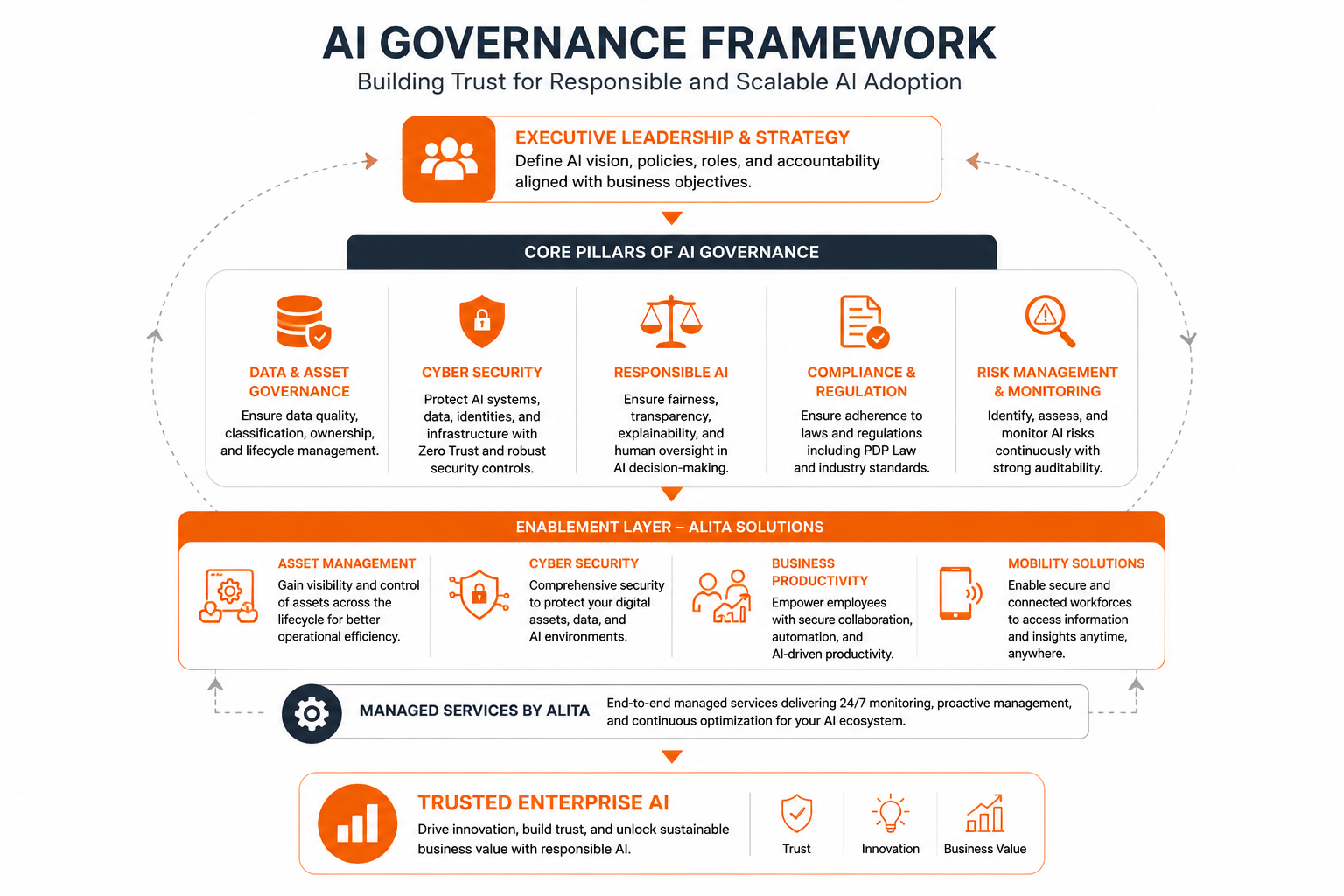
At Alita, we help organizations build that foundation through four integrated solution domains designed to support responsible AI adoption.
Related Solutions from Alita
Asset Management
Create a trusted foundation for AI through intelligent asset lifecycle management, real-time visibility, and reliable operational data that supports informed decision-making.
Cyber Security
Protect AI environments, enterprise data, digital identities, and critical infrastructure with comprehensive cybersecurity solutions, including Zero Trust architecture, identity management, threat detection, and compliance.
Business Productivity
Empower employees with secure digital workplaces, Microsoft AI & Copilot, enterprise collaboration, and workflow automation that improve productivity while maintaining governance and security.
Mobility Solutions
Enable secure, connected operations by providing real-time access to enterprise information for field teams and mobile workforces, ensuring AI-powered insights remain available wherever business happens.
Across all four solution domains, Alita delivers comprehensive Managed Services, providing continuous monitoring, proactive maintenance, technical support, and operational management to ensure enterprise AI environments remain secure, reliable, and optimized for long-term success.
Looking Ahead
Artificial Intelligence is redefining how organizations operate and compete, but sustainable success depends on more than adopting the latest technologies. It requires the governance, security, and accountability needed to ensure AI creates long-term business value.
For Indonesian enterprises, AI governance is quickly becoming a strategic capability rather than simply a compliance requirement. Organizations that establish clear governance frameworks today will be better positioned to protect sensitive data, comply with the Personal Data Protection Law, strengthen cybersecurity, and scale AI with confidence.
As Indonesia continues accelerating its digital transformation, the organizations that lead the next generation of AI adoption will be those that combine innovation with responsible governance—building trusted, secure, and resilient digital businesses for the future.
Written by
Alita Editorial
Ready to Lead Your Industry?
Transform now.
Tags:
Related Articles
What Should a Company Do in the First 72 Hours After a Data Breach?
A step-by-step guide for companies on handling data breaches in the first 72 hours under Indonesia’s PDP Law.

Private AI vs Public AI: Which Is Right for Your Enterprise?
How to decide where your AI workloads should live, based on security, compliance, cost, and what your organization can realistically operate.