
GenAI-Driven SecOps: Why Cybersecurity Must Evolve as Fast as AI
Artificial Intelligence (AI) is rapidly reshaping how organizations operate. From automating routine processes to accelerating decision-making and improving productivity, AI has become a key driver of digital transformation across industries.
Yet every technological leap brings new challenges. As organizations increasingly adopt Generative AI (GenAI), they are also entering a more complex cybersecurity landscape where opportunities and risks evolve at the same pace.
The same technology that empowers businesses to innovate faster can also be leveraged by cybercriminals to launch more sophisticated attacks. As a result, cybersecurity is no longer solely an IT concern. It has become a critical business priority that directly impacts operational continuity, compliance, and long-term resilience.
The New Security Reality in the Age of AI
Today's organizations operate in highly connected digital environments. Cloud platforms, remote workforces, business applications, IoT devices, and AI-powered systems have significantly expanded the digital attack surface.
At the same time, cyber threats are becoming more intelligent and harder to detect. AI is increasingly being used to automate phishing campaigns, accelerate vulnerability discovery, and generate more convincing social engineering attacks. This shift creates new challenges for security teams that are already managing growing volumes of alerts, data, and potential risks.
According to industry reports, the financial and operational impact of cyber incidents continues to rise globally. Beyond direct financial losses, organizations face reputational damage, regulatory consequences, and business disruptions that can affect long-term growth.
In this environment, traditional reactive security approaches are no longer enough. Organizations need greater visibility, faster response capabilities, and a more proactive way to identify and mitigate risks before they become incidents.
From Reactive Security to Intelligent Security Operations
This is where Security Operations (SecOps) plays a critical role.
SecOps combines people, processes, and technology to continuously monitor, detect, investigate, and respond to cyber threats. However, as digital ecosystems become more complex, conventional security operations often struggle to keep pace with the sheer volume of information that needs to be analyzed.
Generative AI is beginning to transform how security teams operate.
By processing large volumes of data at scale, AI can help identify patterns that may otherwise go unnoticed, accelerate incident investigations, reduce operational workloads, and provide contextual insights that support faster decision-making.
More importantly, AI enables organizations to move beyond a purely reactive security posture. Instead of responding only after threats have materialized, security teams can gain earlier visibility into potential risks and take preventive action before significant damage occurs.
The value of GenAI-driven SecOps is not simply about automation. It is about empowering organizations to make better security decisions, faster and with greater confidence.
Building Resilience Beyond Cybersecurity
As cybersecurity continues to evolve, organizations are increasingly focused on three interconnected priorities: compliance, risk management, and cyber resilience.
Compliance remains essential as regulatory requirements surrounding data protection, privacy, and digital governance continue to expand. Organizations must ensure that innovation moves forward without compromising accountability and regulatory obligations.
Risk management is equally important. Cyber risks today extend beyond external attacks and include misconfigurations, third-party dependencies, shadow IT, and emerging technologies that may introduce new vulnerabilities into the environment.
Most importantly, organizations must strengthen their cyber resilience, which is the ability to anticipate, withstand, respond to, and recover from disruptions. In a world where cyber incidents are becoming inevitable, resilience often determines how effectively an organization can maintain business continuity during times of uncertainty.
The question is no longer whether organizations should invest in cybersecurity. The real question is whether their cybersecurity strategy is evolving fast enough to keep pace with the technologies transforming their business.
As AI adoption continues to accelerate, organizations that successfully balance innovation and security will be better positioned to adapt, compete, and grow in an increasingly digital world.
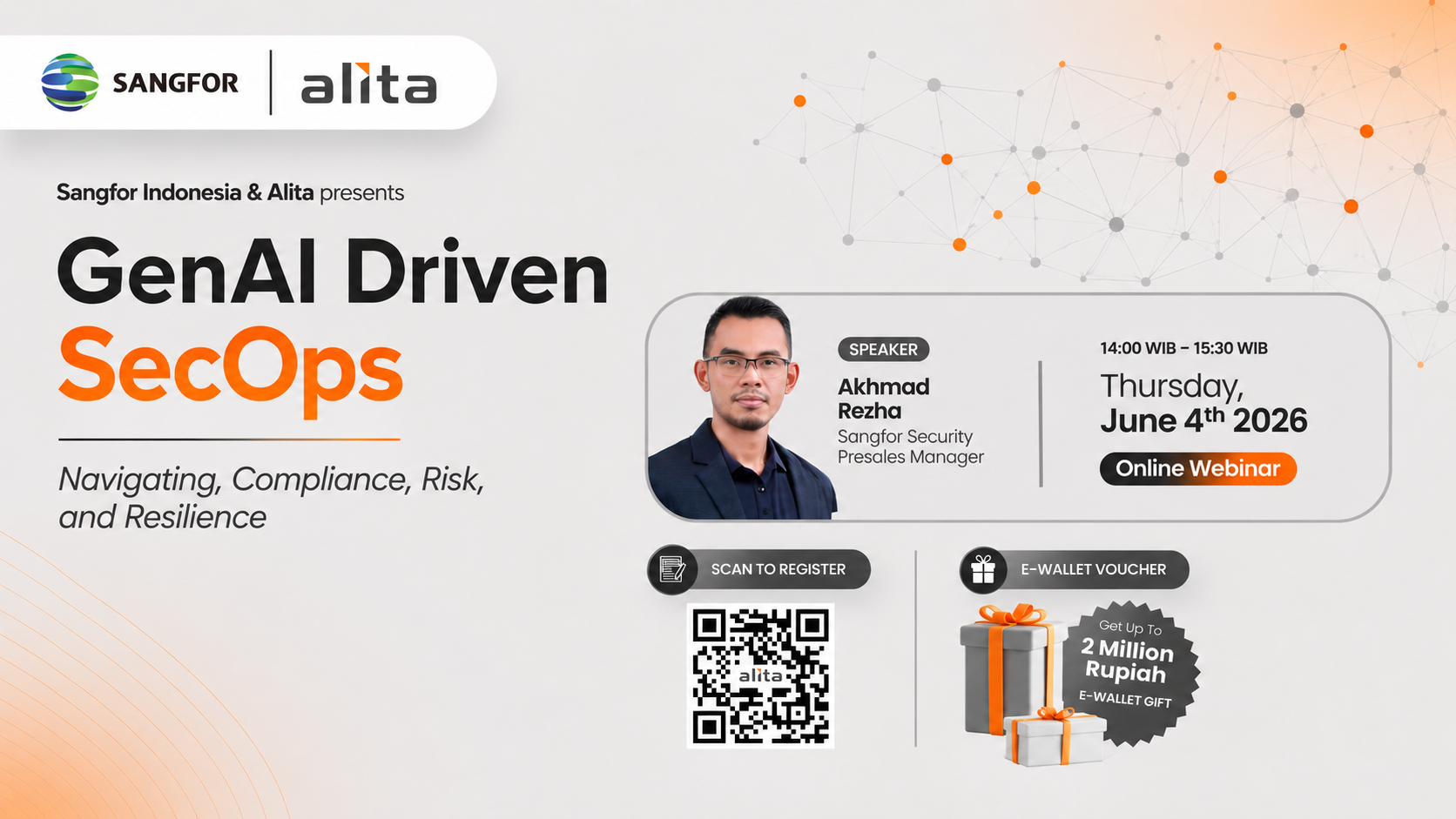
This article is inspired by the webinar "GenAI-Driven SecOps: Navigating Compliance, Risk, and Resilience", hosted by Alita in collaboration with Sangfor. Through initiatives like this, Alita continues to share industry insights and foster discussions around emerging technologies, cybersecurity challenges, and the strategies organizations need to build secure and resilient digital ecosystems for the future.
Written by
Alita Editorial
Ready to Lead Your Industry?
Transform now.
Tags:
Related Articles
Perpres AI 2026: What Indonesia's New AI Regulation Means for Your Enterprise
Indonesia's first national AI regulation is coming. Here's what Perpres AI 2026 means for your enterprise.
AI Governance for Indonesian Enterprises
Learn why AI governance is essential for Indonesian enterprises to scale AI securely, responsibly, and compliantly.